
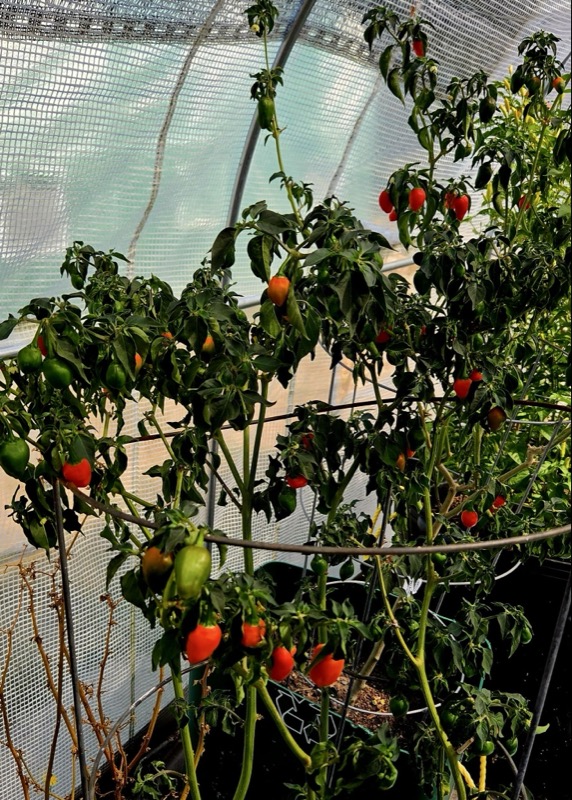
Dalle Khursani
Also known as Akabare Khursani · Akabare · Dalle · Dallay Khursani · Red Cherry Pepper Chilli · Jyaanamara Khursani · Akubari
Dalle Khursani, also called Akabare Khursani or red cherry pepper, is a small round chili from the Himalayan highlands of Nepal and Sikkim, India. It delivers intense heat similar to habaneros alongside a sweet fruity flavor. This polyploid landrace holds a GI tag in Sikkim (extended to Darjeeling and Kalimpong) and serves as a staple in local pickles and condiments.
About 16 times a Capsi Jalapeño (25,086 SHU typical).
Growing
~120 days to maturity
Fruit size
1.5–2.5 cm
Flavor & Use
Surprisingly sweet and fruity with a clean heat that dissipates relatively quickly
Culinary
About
Dalle Khursani is a landrace cultivar of Capsicum annuum primarily grown in the high-altitude regions of Nepal, Bhutan, Sikkim, and the Darjeeling and Kalimpong hills of West Bengal, India. The name derives from the Nepali word for 'round,' reflecting its distinctive cherry-like shape. Fruits are small, approximately 1.5–2.5 cm in diameter, starting green and ripening to a vibrant scarlet red with a soft, fleshy, Serrano-like texture. The plant is bushy and compact, reaching 1 to 1.8 meters in height, and is notably perennial in suitable climates, lasting 5-6 years with winter protection. It is a documented allopolyploid (2n = 4x = 48) and the only well-studied cultivated polyploid landrace in the Capsicum annuum complex. The burn is often described as clean and quick-dissipating. Flavor is surprisingly sweet and fruity, making it versatile beyond pure heat. Traditional uses include pickling as Dalle Achaar, chutneys and pastes for momos, curries, relishes with dal bhat, and fermented preparations with yak buttermilk. Nutritionally, 100 grams of fresh fruit is cited as providing 240 mg vitamin C, 11,000 IU vitamin A, 0.7 mg vitamin E, high potassium, and low sodium. Sikkim received a Geographical Indication tag in 2020 (certificate 14 September 2021, later extended to Darjeeling and Kalimpong), underscoring its cultural and economic significance. Plants thrive in cool, high-altitude conditions and are well-suited to containers.
Backstory
The name 'Dalle' translates to 'round' in Nepali; in Nepal it is also called Akabare (king of chillies) or Jyaanamara (murderer chilli), and in Bhutia Akubari. It is a landrace allopolyploid (2n = 4x = 48) in the Capsicum annuum complex, with no named breeder. NERAMAC filed GI application 636 in December 2018; Sikkim received the tag in 2020, and the certificate dated 14 September 2021 extended protection to Darjeeling and Kalimpong. It remains a cash crop and daily condiment across the eastern Himalaya.
Appearance
Growing
Heritage
ExploreWe don't have a documented family for this pepper yet.
Sources
FAQ
- How hot is Dalle Khursani?
- Capsi’s sourced range is 304,863–456,636 SHU (Lab-verified; typical 393,950). Capsi uses a sourced range and a trust tier, not a single marketing number. How we verify heat: https://web.thecapsi.app/learn/heat-and-capsaicin/how-we-measure-heat
- What does Dalle Khursani taste like?
- Surprisingly sweet and fruity with a clean heat that dissipates relatively quickly
- How do I grow Dalle Khursani?
- Dalle Khursani: about 120 days to maturity, subtropical climate, full sun.
- What can I substitute for Dalle Khursani?
- Habanero peppers, Scotch Bonnet